
Bringing Member Perspective Into the Work Ahead


We asked members what they wanted PAEA leadership to address at this year’s Annual Membership Meeting, and your questions helped shape the conversation.
During the meeting, we focused on three issues that emerged as particularly important to our members and to the work of the Association: accreditation, access to the profession, including the professional degree issue and entry-level doctoral education, and artificial intelligence.
What I took away from the meeting is how important it is to connect PAEA’s national perspective with what our members are experiencing in their programs and institutions. We will not always hear a single point of view, nor should we expect to. But hearing where experiences converge, where they differ, and what questions members are asking gives the Board important context for its work.
I want to share the perspectives raised during the meeting and, importantly, how they connect to the work underway at PAEA.
As you review the results below, context matters. The polls and word clouds were informal pulse checks of Annual Membership Meeting participants. They were not formal votes of the PAEA membership or representative surveys of all member programs. They are one source of insight the Board considers alongside ongoing member engagement, including program director roundtables, listening sessions, member groups, and direct conversations.
Accreditation: From Principles to Practice
Accreditation was one of the issues members asked PAEA leadership to address, and it is an area where the Board has spent considerable time over the past year listening, learning, and defining what it believes strong programmatic accreditation should accomplish.
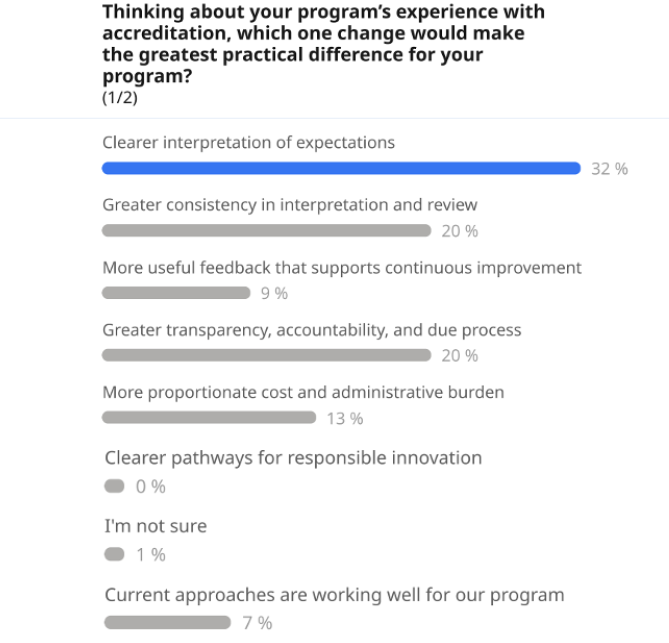
Rigorous external review and public accountability are essential to PA education. At the same time, members have raised concerns about the clarity and consistency of accreditation expectations, transparency and due process, administrative burden and cost, and the ability of programs to innovate responsibly. They have also been clear about what they value: the rigor, accountability, and continuous improvement that accreditation brings to PA education.
Those perspectives, together with research and benchmarking across accreditation systems, informed the Board’s Belief Statement and Guiding Principles for PA Programmatic Accreditation. The principles articulate the conditions the Board believes should characterize effective accreditation, including educational quality, continuous improvement, innovation, fairness, consistency, and accountability.
At the Annual Membership Meeting, we moved from principles to program experience, asking participants to describe their programs’ experience with accreditation today.
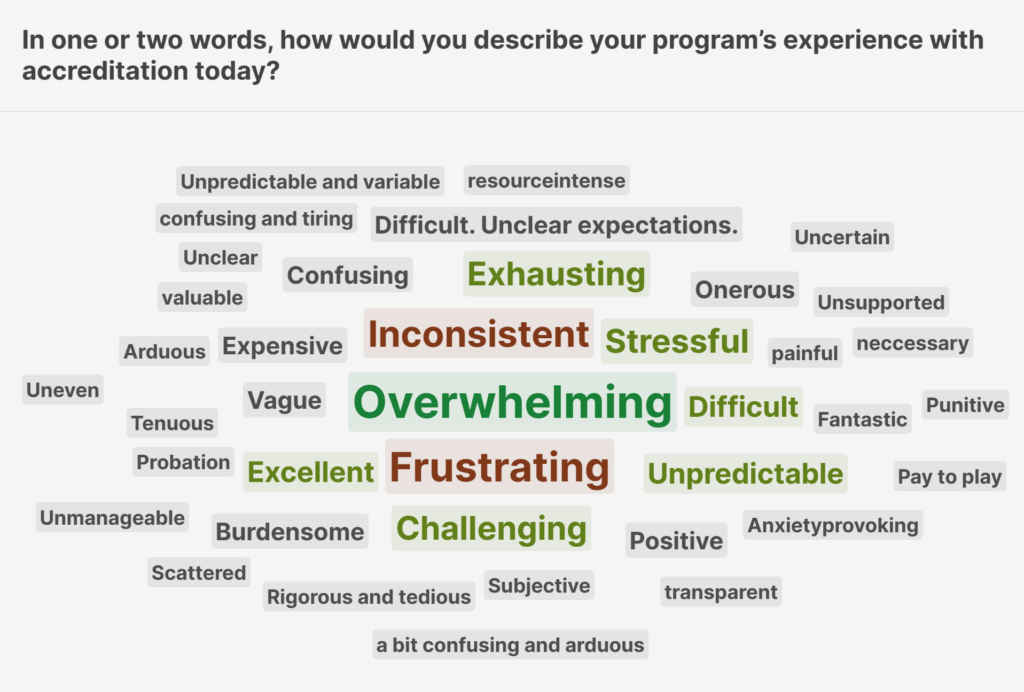
We then asked which single change would make the greatest practical difference for their programs.
Finally, we asked members to look ahead:
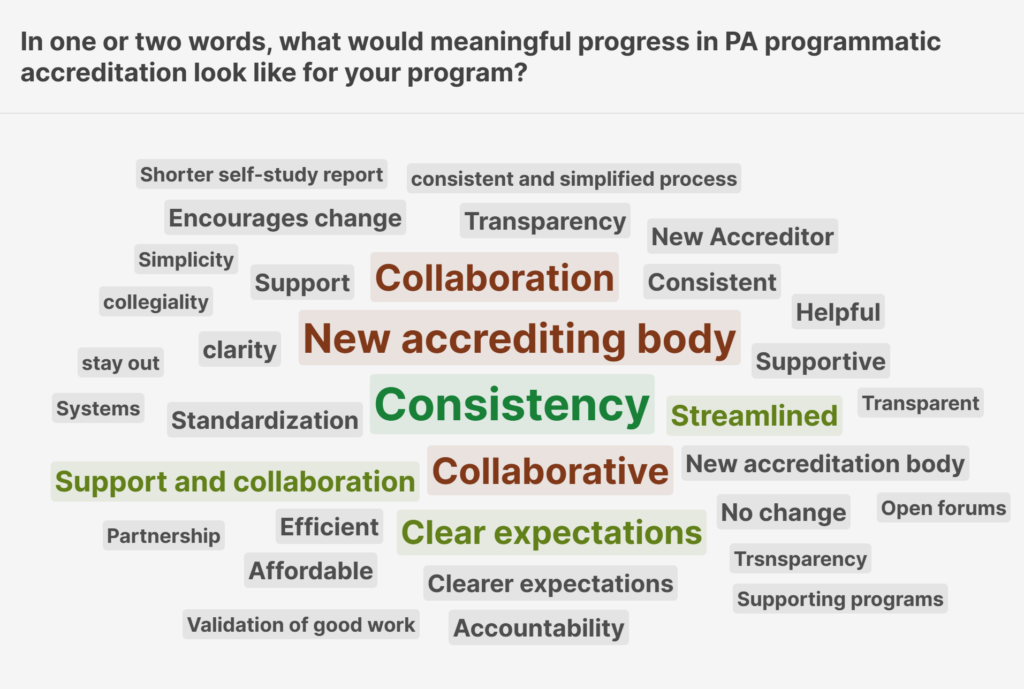
The two word clouds reflect an important contrast. Members described a range of challenges in their experience with accreditation today, as well as a range of perspectives on what meaningful progress could look like. Some of those ideas focus on improving current practices, while others raise broader questions about the accreditation system itself.
The Board’s Guiding Principles provide a framework for continuing to examine what we are hearing, understand where members’ perspectives converge and where they differ, and identify opportunities to strengthen accreditation in PA education. As this work continues, PAEA will continue engaging with members and accreditation partners to explore these perspectives, build a greater shared understanding, and consider how we can collectively advance a rigorous, fair, and effective accreditation system.
Access and the Future of PA Education
Members also asked about the federal professional degree designation and doctoral education. The issues are distinct, but the current environment requires us to consider them together.
The federal professional degree issue has reinforced an important principle for PAEA: access must remain central to decisions about the future of PA education.
This spring, the Department of Education finalized an interpretation of “professional degree” that excluded PA education and several other health professions from access to higher federal student loan limits. PAEA made clear that this was an unlawful departure from what Congress required and, together with AAPA, challenged that interpretation in federal court.
In June, the U.S. District Court for the District of Columbia halted implementation of the narrowed definition while litigation proceeds. Subsequent Department guidance recognized PA programs as eligible for the higher professional borrowing limit during this period. That is important relief, but the litigation continues.
The stakes extend beyond financing policy. If students cannot borrow enough to cover the realistic cost of PA education, access to the profession becomes increasingly dependent on personal financial resources.
That reality also shapes how the Board is thinking about an entry-level doctorate. PAEA’s Doctoral Education Commission has completed its charge and contributed important scholarship to the conversation about the future of the entry-level degree. In the current environment, the Board’s focus is protecting the financial pathway into PA education and understanding what pressures around access and affordability mean for students, programs, and the profession.
We nevertheless wanted to understand where meeting participants stand today.
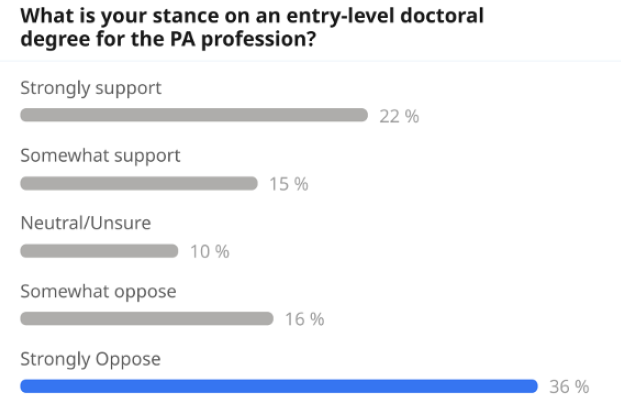
As a reminder, this was a pulse check, not a formal membership vote, and it does not establish or change PAEA policy. The membership’s 2023 policy remains in effect: the master’s degree is the terminal and entry-level degree for the profession, while doctoral degrees are recognized as an increasingly important contributor to PA education and the profession.
AI: Building Capacity for What Comes Next
AI is already becoming part of the landscape of PA education, from admissions and assessment to teaching, learning, and the day-to-day work of educators. But adoption is only part of the story. Programs are also navigating questions about appropriate use, academic integrity, bias, institutional policy, and where human judgment must remain paramount.
PAEA has an important role in helping members navigate those questions, not by prescribing a single approach, but by building the evidence, guidance, and shared learning that support thoughtful decisions.
At the Annual Membership Meeting, we began by asking participants where they are today.
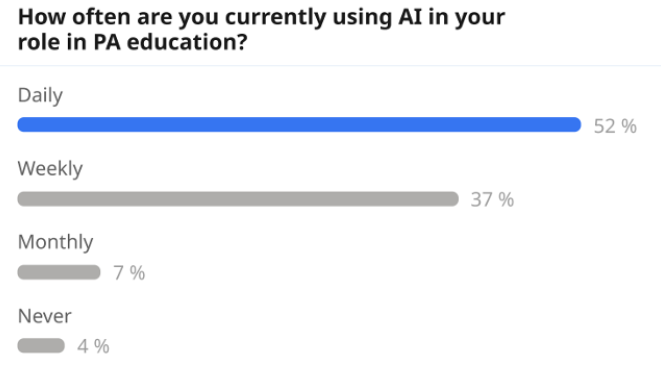
We also asked members to describe the barriers or challenges they are encountering as they incorporate AI into PA education.
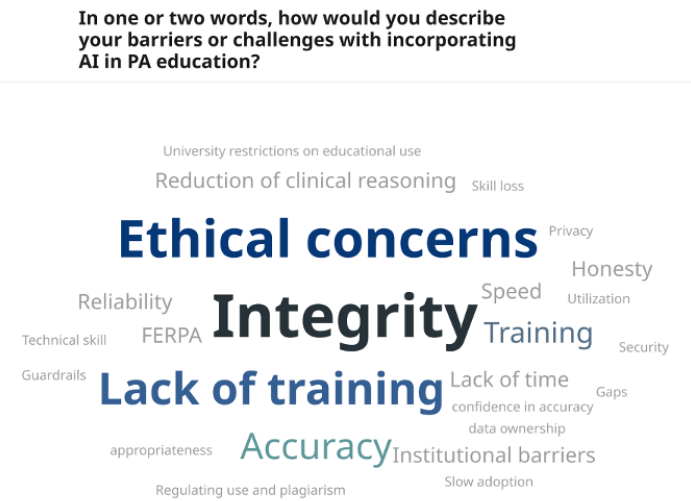
What I find encouraging is that members are not simply asking whether AI belongs in PA education. They are asking harder questions about where it adds value, where the risks are, and what responsible use should look like.
Those questions point to an important role for PAEA: helping programs move from uncertainty and experimentation toward informed, responsible practice. We asked participants where PAEA’s support could make the greatest difference.
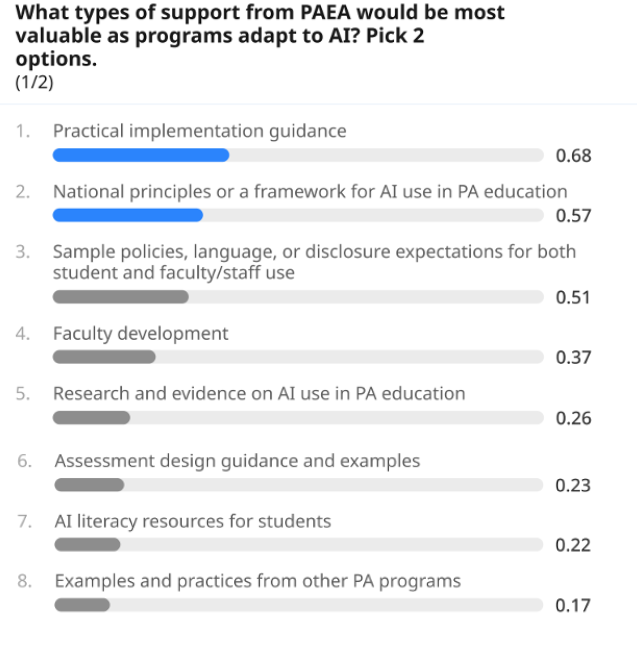
That input will help shape the next phase of our work. We intend to bring together members with expertise in AI to help develop practical resources and educational opportunities, while continuing to learn from the work already happening across our community.
Our goal is not to determine whether PA education should use AI. It is to help programs navigate its use thoughtfully and responsibly, while keeping educational judgment at the center of PA education.
Carrying the Conversation Forward
The value of this conversation is not that it produced a single answer on accreditation, doctoral education, or AI. These are complex issues, and the perspectives across our community will not always be uniform. Its value lies in bringing those perspectives into a broader understanding of what PA education needs and where PAEA can make a meaningful difference.
That is one of the responsibilities of a national association. We can see across programs and institutions, connect individual experiences to broader trends, bring research and data to the questions our members are raising, and identify where collective action can move PA education forward.
Members helped set the agenda for this year’s meeting, and your participation added depth to the conversation. I came away with a clearer understanding of where members are looking to PAEA for leadership and where we need to keep asking questions. For the Board, that means translating what we heard into focused action: strengthening the systems that support PA education, protecting access to the profession, and helping educators prepare for what comes next.


