

End of Curriculum™ Faculty Guide
The End of Curriculum Faculty Guide is available to introduce programs to this exam.
 View PDF
Faculty Guide Highlights
The PAEA End of Curriculum exam may be delivered in the final four months of matriculation as a component of a student’s summative assessment. It is designed to complement other tools that assess core medical knowledge as well as other competencies required by current accreditation standards.
Exam Delivery, Format & Duration
The End of Curriculum is required to be taken in-person with a live proctor in PAEA’s designated lockdown browser.
The PAEA End of Curriculum Exam is comprised of five 60-question sections. Of these 300 questions, 250 are operational (scored) and 50 are pre-test (unscored). The inclusion of unscored items enables PAEA to continue ongoing exam maintenance and to build a validated test bank.
To help ensure exam security and to prevent over-exposure of exam content, PAEA publishes multiple equivalent exam forms. These forms are equated in terms of content, difficulty, and reliability. Students are randomly assigned one of these forms on exam registration.
The End of Curriculum exam is a multiple-choice exam which uses a “one best answer” format. Items are comprised of a stem and answer options. The stem typically consists of a clinical scenario or vignette and a lead-in question. The answer options consist of four or five answer choices: the correct or best answer (known as the key) and three or four incorrect or inferior alternatives (known as distractors). The items are of a varying degree of complexity, with the vignette format not only allowing for the measurement of higher-order thinking skills but also providing a better approximation of real-life practice.
The End of Curriculum Exam is five hours long and scheduled for one day. Students are allotted 60 minutes per section, with four optional 10-minute breaks between sections, as well as an optional 10-minute tutorial before the start of the exam.
Students requiring time-based accommodations granted under the Americans with Disabilities Act must take the exam over two days. PAEA allows time extensions of time-and-a-half or double time. Administration days do not need to be sequential but must be completed within seven days of each other.
- Students receiving a time-and-a-half accommodation are granted 45 minutes per 30-question section with optional 10-minute breaks between sections.
- Students receiving a double-time accommodation are granted 60 minutes per 30-question section with optional 10-minute breaks between sections.
If a student fails their first attempt, a second attempt may be scheduled for no earlier than 42 days, or six weeks, after the first attempt. This ensures that the student and program have adequate time to develop and implement an individualized remediation plan.
A different form will be delivered for the retake. Students are permitted only one retake attempt.
Exam Content
By design, the organization of the exam blueprint is multidimensional. The structure is organized by enstrustable professional activities (EPAs), content areas, and task areas.
The 12 Content Areas correspond to organ systems, the knowledge of which is assessed on the End of Curriculum exam. Each system is further divided into the disease processes that are associated with the organs and tissues within that system and published in the End of Curriculum’s Content Area List.
The content areas on the End of Curriculum exam are:
- Cardiovascular
- Pulmonary
- Gastrointestinal
- Neurologic
- Psychiatric/Behavioral Health
- Endocrine
- Eyes, ears, nose, oral cavity, and throat (EENOT)
- Gynecologic/Reproductive Health
- Rheumatologic/Musculoskeletal
- Dermatologic
- Hematologic
- Renal/Genitourinary
We recognize that topics on the content area list are considered only a sample of what might be covered in PA education. As such, note that the content area list is not intended to be all-inclusive. Furthermore, content areas are organized to include topics in broad categories and do not necessarily indicate a greater importance or emphasis on that area in the exam.
Core Tasks and Objectives are assessed by all the PAEA examinations (PACKRATTM, End of RotationTM, and End of Curriculum). The core tasks and objectives on the End of Curriculum exam are:
- History and Physical
- Diagnostic Studies
- Diagnosis
- Clinical Intervention
- Clinical Therapeutics
- Health Maintenance
- Scientific Concepts
- Professional Practice
The End of Curriculum Exam is developed with key dimensions to ensure the exam is inclusive of the types of cases PAs may see, including in the areas of setting and life course. The tables below represent item distribution targets set for the entire exam, across the content and task areas:
| Setting | Percent |
| Outpatient | 50% |
| Inpatient | 20% |
| Emergency Department | 16% |
| Perioperative | 10% |
| Rehabilitative | 4% |
| Life Course | Percent |
| Pediatric (birth to age 17) | 20% |
| Adult | 60% |
| Geriatric (older person with considerable impairment or frailty) | 20% |
For the End of Curriculum exam, PAEA has adopted the following three Policy Level Descriptors: Advanced Medical Knowledge, Satisfactory Medical Knowledge, and Limited Medical Knowledge.
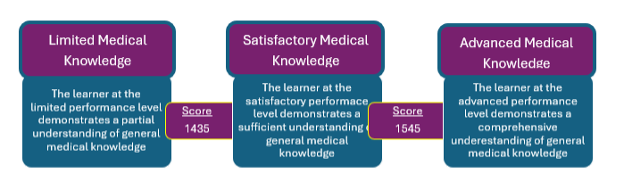
Scale scores are scores that have been mathematically transformed from one set of numbers (i.e., the raw score) to another set of numbers (i.e., the scale score), in order to make them more easily comparable between different forms of the same exam. Involved in scaling is a process known as equating, which ensures that no student is disadvantaged or advantaged by taking a more difficult or less difficult exam form.
The primary benefit to scale scores is that they allow all scores on all versions and forms of the End of Curriculum exam to be comparable across years as they all use the same scale metric. Additionally, this process corrects for variations in test form difficulty, ensuring that equivalent levels of performance result in the same scaled score regardless of the form administered.
The scale for the End of Curriculum exam is 1200 to 1800.
Every student receives a scale score and a graphical representation of their score compared to the national average. Feedback is provided by content and task areas, by Entrustable Professional Activities (EPAs), patient care setting, life course, and Bloom’s Taxonomy level. For comparative purposes, this information is also paired with national comparison data in the program’s composite and cohort performance reports.
Score Reports
The Student Report shows how the student performed on the exam compared to national averages. Subscores help the student identify strengths and weaknesses in content areas and task areas relative to national average performance. The report can be downloaded as a PDF file for the student and faculty to review together.
The Cohort Performance Report shows program faculty how a student cohort compares to national averages in both overall and subscores. The report also provides a comparison of the cohort’s score distribution to a reference population across the performance levels.
The Composite Report organizes student scores by cohort to facilitate gradebook entry. The report shows each student’s overall score and subscores, the date they took the exam, and whether the results have been released to the student. The subscores can be organized by Content Area, Task, EPA, Setting, Life Course, and Bloom’s Taxonomy. The report can be exported as a comma-delimited file (i.e., .csv).